
Compare Newton County Property Value Types
Name the number before comparing anything. Indiana assesses at a 100 percent ratio to market value-in-use, yet a mass-appraisal estimate and a real sale remain different things. The Department of Local Government Finance assessment overview spells out the statewide standard. The county parcel detail holds the local record.
| Value | What It Is | Where |
|---|---|---|
| Assessed value | Mass-appraisal figure used in the property tax system | Auditor parcel detail and DLGF records |
| Market value-in-use | Indiana's standard for the property's current use | Assessor methodology and assessment record |
| Last sale price | Consideration from an actual transfer, when publicly reported | Sales disclosure and recorded transfer clues |
| Land and improvements | Components used to understand how the total was built | Assessment detail and ratio-study data |
A sale price reflects one deal. It is the product of a single transaction and its conditions, while an assessed value comes from a countywide process built on sales, grouping, trending, cost data, and property characteristics. Neither number alone tells you what another buyer would pay today.
Read Newton County's Assessed Value Fields in Context
The Newton County Auditor portal looks up parcels by parcel number, owner name, or property address. The detail page is dense. It can show the assessment year, deductions, gross tax, credits, balances, payments, transfers, deeded owner, deed references, and a value history. That history sits beside the current tax fields. So the year matters whenever two figures get compared.
The portal itself warns "Not for Official Use." Write down the year and update date with any figure. When an official assessment is required, turn to the Assessor or the DLGF record. A tax balance is a balance. Never lift one and call it property value.
Note: Assessment, deduction, credit, tax charge, and unpaid balance are separate fields even when they appear on the same parcel page.
Follow Newton County Value Changes Through Reassessment
Indiana's new four-year cyclical reassessment begins July 1, 2026 for 2026 pay-2027 work. The DLGF schedule sets the pace. Roughly 25 percent of parcels are inspected each year. A parcel value can move for that reason alone. Annual adjustment can move it too, with no deed transfer at all. So compare like years and like components. A later figure may reflect new improvements, changed condition, trending, corrected data, or reassessment rather than appreciation. Call it appreciation only with evidence about why the record moved.
Use Indiana's Assessed Value Route for Newton County
The state also maintains an official assessed-value search guide that points users toward county and Gateway records. Its search and download context is useful when comparing Newton County with a statewide source.
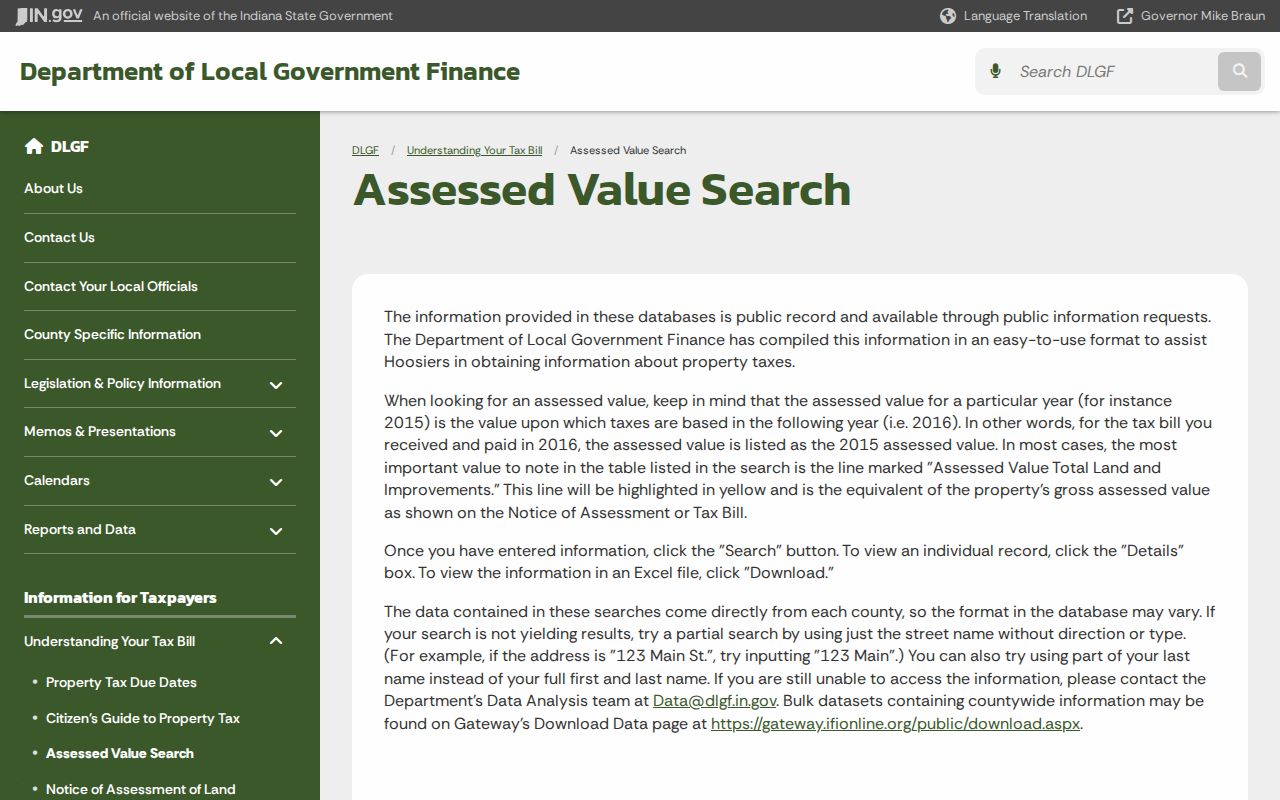
That page drives home the point. An assessed figure belongs to a dated public tax record, and it must be read with its county, parcel, and assessment year attached.
Newton County's Limited Sales Shape Value Analysis
Newton County sells lightly. DLGF's 2023 narrative for the county describes limited neighborhood sales. It also shows heavy reliance on grouping, trending, and cost tables. Commercial and industrial activity clusters around Kentland and Morocco. Rural parcels may need a broader evidence set. The 2024 narrative adds that permit information helps update parcels. This applies when an interior inspection is not available.
This method explains why one neighboring sale rarely dictates an assessment. Property class matters. So do township, neighborhood grouping, land and improvement components, and current use. Goodland's reported market-factor increase is a specific study finding. It is not proof that every Goodland or Newton County property value rose.
Estimate a Newton County Property Value From the Records
Record each number with its source and effective year. That habit keeps a lookup honest. Start at the parcel card, then check the statewide sales-disclosure search for a transaction comparison; the result is a documented comparison, not an appraisal.
- Search the address or parcel and verify the tract and assessment year.
- Record the total assessed value plus any land and improvement components shown.
- Check the public sales-disclosure search for a post-July 2008 transfer.
- Compare only relevant sales and keep dates, classes, and use differences visible.
- Assessed value
- The mass-appraisal value used in tax administration.
- Market value-in-use
- Indiana's value standard for the property's current use.
- Assessment ratio
- The relationship between assessment and the governing value standard.
- Sale consideration
- The amount reported for a transfer, subject to transaction context.
Compare Newton County Property Value With Recorded Sales
Indiana's Sales Disclosure Form search covers public disclosures filed after July 1, 2008. DLGF ratio-study rows can carry a lot. They include parcel number, township, neighborhood, class, taxing district, sale date, sale price, land value, improvement value, total assessment, and ratio. Those fields support careful comparisons. Keep the transaction date visible throughout.
A deed or disclosure can be a family transfer. It may bundle multiple parcels or carry other conditions that weaken it as a market comparison. Newton County deed images do not always show a sale price field, so never assume the amount will appear.
Do Not Confuse Newton County Deductions With Value
Parcel detail pages place several figures side by side. Assessed value, deductions, gross tax, credits, charges, and balances all crowd the same screen. Deductions affect the tax math. They do not redefine the land's gross assessed value. A payment shifts the balance. It never touches the valuation. For bills, exemptions, due dates, and appeals, use the county's property tax guidance rather than reading values into those fields.
Keep the Year on Every Newton County Property Value
Years make the comparison. Write them down. The Auditor's list and statistics pages carry update dates, while assessment rows carry tax or assessment years. DLGF also publishes annual county budget orders, certified assessed values, and ratio studies. Labels matter. A 2025 parcel value set against a later sale or the 2026 reassessment without labels invites a false conclusion.
Keep records tidy. Save the source, effective year, inspection or reassessment context, and parcel number with every figure. If the current record differs from a notice, contact the Newton County Assessor at 201 N 3rd Street in Kentland, (219) 474-6081, Monday through Friday from 8 a.m. to 4 p.m.
What Newton County Property Value Records Cannot Promise
Newton County assessors set values for one purpose: taxation. The assessor value on a parcel record serves public assessment and the tax roll. It is not a private appraisal, a guaranteed sale price, a repair estimate, or a title conclusion. The same caution applies to GIS parcel lines. These never prove acreage or legal boundaries on their own.
Value is not price. A Newton County assessed value is not what a property is guaranteed to sell for. Obtain a qualified appraisal when a transaction requires a current opinion.
Match each record to the question it answers. A sound value estimate brings together the parcel record, the assessment year, sale evidence, property class, and current condition. For a tax bill dispute, that work matters. Use the official assessment notice and the county appeal process instead of arguing from an unlabeled figure on the web.